Transformation digitale : pourquoi 67% des PME échouent ?221
Les entreprises perdent des milliers d'euros en négligeant ces trois pièges critiques lors de leur transition numérique.

Transformation digitale : pourquoi 67% des PME échouent ?221
le
13 janv. 2026

The Foundation: Mastering Your Core for Sustainable Growth
Business growth strategies are structured approaches companies use to increase revenue, expand market share, and scale operations sustainably. The most effective strategies include market penetration, product development, market expansion, and diversification—each with distinct risk profiles and resource requirements.
Quick Answer: The Four Primary Business Growth Strategies
Market Penetration - Maximize sales of current products to your existing customer base
Product Development - Create new offerings or improve existing ones for current markets
Market Development - Take existing products to new geographic areas or customer segments
Diversification - Introduce new products into entirely new markets (highest risk, highest potential reward)
Growing a business is hard. The data tells a sobering story—only 25% of companies grow sustainably over time, and the typical company grows at a measly 2.8% per year, barely keeping pace with inflation.
For many small and medium-sized businesses, this challenge is acute. Manual processes consume time, the digital presence feels outdated, and opportunities are missed because systems can't keep up. You know you need to grow, but you're stuck in the day-to-day grind.
Sustainable growth isn't accidental; it's the result of deliberate, strategic choices. Companies that grow sustainably generate seven percentage points more annual shareholder returns than their peers by following proven pathways and executing with discipline.
This guide breaks down the essential strategies for scaling your business—from mastering core operations to exploring new markets. You'll find a clear roadmap to optimize what you do well or venture into new territory.
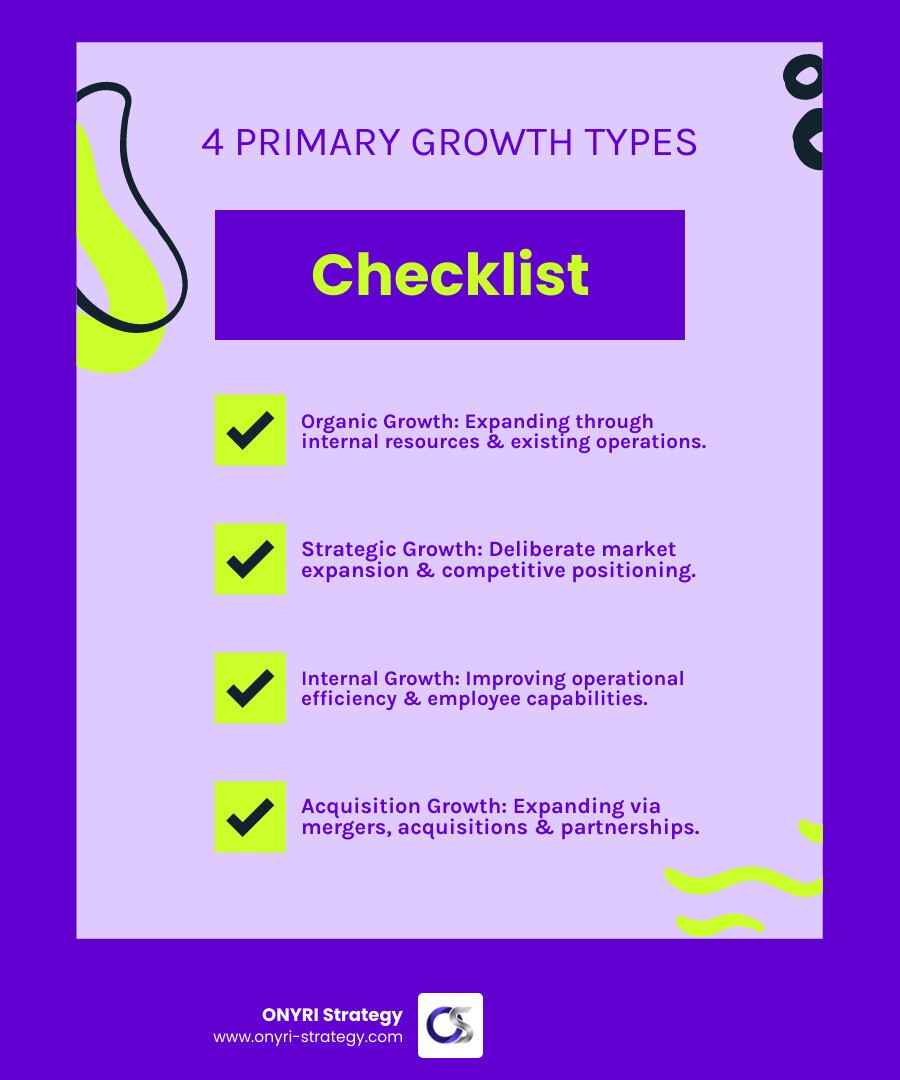
Before chasing new opportunities, focus on the bedrock of any thriving business: a strong core. Our research shows that, on average, more than 80% of total revenue growth is derived from the core business. Achieving excellence in current operations is crucial.

Mastering the core boils down to a few key areas:
Organic Growth vs. Strategic Growth: A Clarification
Organic Growth is expanding your business through internal resources and operations, like selling more of your current products without acquiring other companies. It's typically slower and steadier.
Strategic Growth is a broader term for any deliberate expansion effort, including organic methods and inorganic ones like acquisitions. It involves making conscious choices to achieve specific growth objectives.
To effectively "turbocharge" your core, focus on what you already do best and "grow where you know." This means leveraging existing advantages, understanding current customers, and relentlessly improving internal processes.
Internal Operational Efficiency: The Unsung Hero of Growth
Inefficient operations are like a leaky bucket. Internal operational efficiency plugs those holes by streamlining processes, reducing waste, and cutting unnecessary costs. Optimizing workflows and automating repetitive tasks frees up valuable resources—time, money, and human capital—that can be reinvested into growth. For instance, we help SMEs by providing custom digital solutions to automate workflows, which can significantly save time and boost client generation. More info about automated workflows can be found on our blog.
The Role of Customer Feedback and Customer Retention for Sustainable Growth
Customer feedback provides invaluable insights into what you're doing right and where you can improve. Acting on their suggestions helps refine offerings and build stronger relationships, which directly boosts customer retention.
Retaining existing customers is far more cost-effective than acquiring new ones. Loyal customers provide steady revenue and become brand advocates. If you're seeing signs of a shrinking customer base, it's time to act. How to monitor an inactive client base offers crucial insights.
Investing in Employee Development: Growing from Within
Investing in employee development—through training, mentorship, and career advancement—directly contributes to business expansion. Skilled, motivated employees are more productive, innovative, and better equipped to deliver exceptional customer experiences. This fosters a positive work culture and ensures you have the talent pipeline to support future growth.
The Ansoff Matrix: Your Strategic Map for Business Growth Strategies
Once the core is strong, you can explore strategic pathways for expansion. A brilliant tool for this is the Ansoff Matrix, developed by H. Igor Ansoff in his 1957 Harvard Business Review article, "Strategies for Diversification." This matrix categorizes growth opportunities based on two dimensions: products (existing vs. new) and markets (existing vs. new).

The Ansoff Matrix lays out four fundamental product/market combinations, each with its own risk level:
Market Penetration: Existing Products, Existing Markets (Lowest Risk)
Product Development: New Products, Existing Markets (Medium Risk)
Market Development: Existing Products, New Markets (Medium Risk)
Diversification: New Products, New Markets (Highest Risk)
This matrix acts as a compass for your growth journey, helping you visualize your options and their inherent risks. For those who love a good historical read, you can check out The original HBR article on diversification strategies.
Let's explore each quadrant:
Market Penetration: Dominating Your Current Market
This is the safest and most immediate way to boost growth. Market penetration focuses on increasing market share with current products in your existing customer base. It's about selling more to people who already trust you or winning over competitors' customers.
Strategies here include:
Aggressive Marketing and Sales: Ramp up promotional efforts, optimize sales funnels, and clarify your unique value proposition.
Competitive Pricing Strategies: Analyze competitors' pricing and your cost structures to find the right balance between profitability and affordability. How your product is differentiated will impact its perceived value.
Enhancing Customer Loyalty: Loyalty programs, exceptional customer service, and personalized communication can significantly increase repeat purchases.
The Role of Digital Marketing: SEO (Search Engine Optimization) ensures your business is visible when customers are searching for solutions. Content marketing, through blogs and valuable resources, positions you as an authority and attracts organic traffic. For example, Zapier generated 72% of its organic website traffic from SEO-focused blogs. You can also leverage social media, email marketing, and paid advertising to reach your target audience. Learn about the profitability of SEO vs SEA to make informed marketing budget decisions. And don't forget local SEO! How to optimize your Google My Business profile can help you dominate your local market.
Product Development: Innovating for Your Existing Customers
When market penetration is maximized or existing products are maturing, product development is a compelling strategy. This involves creating new or improved products for your existing customer base, leveraging what you already know about their preferences and unmet needs.
Approaches to product development include:
Modifying Existing Products: Add new features, improve performance, or offer different quality levels. For instance, a software company might release a "Pro" version of its popular tool.
Creating New Offerings: Develop entirely new products that align with your brand and would be valuable to your existing customers, like a restaurant developing a line of packaged sauces.
Fostering Continuous Innovation: Companies that prioritize continuous innovation are better equipped to adapt to market dynamics and leverage emerging technologies. This helps maintain a competitive edge and ensures long-term growth. To ensure new products succeed, consider A/B testing features or messaging. How to run your first A/B test can guide you.
Market Development: Conquering New Territories
This strategy involves taking your existing products to new markets, such as new geographic areas or new customer segments.
Key considerations for market development:
Expanding to New Geographic Areas: This could be another city, region, or country. Thorough market research is essential to understand local demand, competition, regulations, and cultural nuances.
Targeting New Customer Segments: Your product might serve a new audience. For example, a B2C product could be adapted for a B2B market.
Becoming a 'Local Hero': Before expanding broadly, it's often wise to consolidate your position in your home market or a specific new region. This builds a strong reputation and momentum for further scaling.
Considerations for Global Expansion: Venturing internationally requires careful planning. Assess if your competitive advantage is transferable. Our research shows that companies that expanded internationally generated 1.9 percentage points more annual TSR than their industry peers. However, businesses with healthy growth in their home markets typically benefit more.
Diversification: Exploring New Products and Markets
Diversification is the riskiest strategy, as it involves introducing new products into new markets. It's often considered when core markets are saturated or existing products are in decline.
Associated Risks and Rewards: The risk is high due to unfamiliarity with both the product and the market. However, the rewards can be substantial, offering new revenue streams and reducing reliance on a single market.
Expanding into Adjacent Industries: A common form of diversification is moving into related fields by leveraging existing capabilities or customer relationships. For example, a coffee machine company might diversify into selling premium coffee beans. Our research indicates that companies that expanded into adjacent industries generated, on average, an extra 1.5 percentage points per year of shareholder returns above their industry peers. Furthermore, companies growing in a way that increases the similarity of their portfolios earn, on average, an additional one percentage point of TSR per annum.
Looking Beyond the Core Business: This strategy encourages creative thinking about your assets and expertise to identify entirely new opportunities, which could mean building or acquiring new businesses. More info about choosing between a showcase site and e-commerce might help you evaluate the best platform for new product lines.
Accelerating Your Trajectory: Inorganic Growth & Strategic Alliances
To accelerate growth, companies can turn to external means like inorganic growth and strategic alliances, which offer faster routes to scale and market presence.

Key considerations for your acquisition business growth strategies
Acquisition growth involves purchasing another company to gain market share, technology, or market access. It's a powerful strategy when speed is critical or when developing assets internally is too slow or costly. Mergers and acquisitions (M&A) account for approximately one-third of the revenue growth among companies in our data set.
However, acquisitions have complexities:
Financial and Operational Risks: Acquisitions carry a substantial price tag and the risk of complex, disruptive integration.
Integrating Company Cultures: A major challenge is merging company cultures. Our research highlights that "culture is not easily measurable." Mismatched cultures can lead to conflict, decreased morale, and lower productivity. Successful integration requires clear communication and a shared vision.
Programmatic Acquisitions: Instead of single large deals, some companies use "programmatic acquisitions"—a series of smaller, strategic purchases. This approach can yield better shareholder returns and less disruption than large deals or pure organic growth.
Budgeting for Integration: Remember to budget for the costs of integrating systems, processes, and people beyond the initial purchase price. Comparing the budget for no-code vs. a developer can offer perspective on resource needs for tech integration.
The Power of Partnerships and Ecosystems
Strategic partnerships, joint ventures (JVs), and ecosystems offer growth opportunities with less risk than a full acquisition. These collaborations allow companies to combine strengths, share resources, and expand reach efficiently.
Benefits of Strategic Alliances:
Co-marketing and Cross-promotions: Partner with complementary businesses to tap into new customer bases.
Resource Sharing: Share technology, distribution channels, or expertise.
Access to New Capabilities: Gain access to specialized skills or technologies you lack internally.
Reduced Risk: Mitigate the risks of new ventures by sharing the investment.
Building a Network of Complementary Businesses: Proactive leaders continually look for collaborators. Our research shows that leaders are 30 to 50 percent more likely to continually scan for alliances, joint ventures, and M&A opportunities. This approach builds robust ecosystems that provide a competitive advantage. For example, to expand your B2B network, How to automate your LinkedIn prospecting can be a strategic tool for finding partners.
Execution is Everything: Building a Holistic Growth Blueprint
A great strategy is useless without flawless execution. A holistic growth blueprint is a living framework that guides actions, deploys resources effectively, and aligns the entire organization toward a common goal.
The core elements of this blueprint include:
Setting an Aspirational Mindset and Culture: Growth is a mindset. Leaders must choose to grow and foster a culture that accepts innovation, risk-taking, and continuous improvement.
Activating the Growth Pathways: Consciously choose from the strategies discussed: turbocharging the core, innovating into adjacencies, or launching breakout businesses.
Executing with Excellence: This involves resource allocation, operating models, and developing essential functional capabilities.
Resource Allocation and Operating Models: Many strategies falter here. Be purposeful in investing in growth initiatives. Our research found that leaders who fully commit to growth are 60 percent more likely to regularly reallocate resources from lower-return to higher-return spaces. This means dynamically shifting capital and talent to where they will generate the most impact, potentially using multiple operating models for different initiatives.
Essential functional capabilities for your business growth strategies
To execute effectively, you must build and improve specific functional capabilities:
Data Analysis: The ability to collect, analyze, and interpret data is paramount for understanding customers, markets, and performance. Growth leaders are 60 percent more likely to have successfully used AI and advanced analytics to predict customer behaviors. Don't have a data analyst? How to track digital KPIs without a data analyst can show you how.
Sales Process Optimization: A tuned sales process ensures efficient lead conversion and maximum revenue.
Digital Marketing Expertise: Strong digital marketing skills are crucial for reaching new markets and customers.
Innovation Culture: An environment that encourages and scales new ideas is vital for product development and diversification.
Customer Experience (CX) Capabilities: Improving the customer journey builds loyalty and creates a competitive advantage.
The 'Shrink to Grow' Paradox and Strategic Reallocation
Sometimes, to grow bigger, you must first get smaller. The "shrink to grow" strategy involves divesting underperforming assets to free up resources for high-growth areas. It's about pruning the portfolio to ensure every part of the business contributes to growth.
Research shows this works. Companies using "shrink to grow" strategies generated five percentage points more annual excess TSR than inconsistent growers and large-deal acquirers. This approach requires the discipline to make tough choices today for a stronger tomorrow. Understanding where your marketing budget is best spent is key. How to allocate your web marketing budget provides valuable insights.
Frequently Asked Questions about Business Growth Strategies
Here are answers to common questions about business growth strategies.
What are the 4 main types of growth strategies?
Based on the Ansoff Matrix, the four main growth strategies are:
Market Penetration: Increasing sales of existing products in existing markets.
Product Development: Creating new products for existing markets.
Market Development: Taking existing products to new markets.
Diversification: Introducing new products into new markets.
Each offers a different balance of risk and reward.
How can a small business grow quickly?
Quick growth for a small business often comes from a combination of focused strategies:
Leverage Digital Marketing: Maximize online presence through SEO, social media, and targeted ads.
Optimize Operational Efficiency: Streamline internal processes to free up resources for growth.
Prioritize Customer Retention: Focus on loyalty, as existing customers are your most reliable revenue source.
Form Strategic Partnerships: Collaborate with complementary businesses to expand reach without significant investment.
Innovate Continuously: Stay agile by regularly improving products or services.
What is the difference between organic and inorganic growth?
The primary difference is the method of expansion:
Organic Growth: Achieved through a company's internal efforts, like increasing sales, developing new products, or improving efficiency. It's a slower, more controlled process.
Inorganic Growth: Achieved through external means, primarily mergers and acquisitions (M&A). This involves buying other companies to instantly gain market share or technology. It's faster but carries higher financial and integration risks.
Conclusion: Choosing to Grow with a Clear Strategy
Sustainable business growth isn't an accident; it's the result of a deliberate choice backed by a clear strategy and relentless execution. Whether mastering your core, expanding into new markets, innovating products, or forming strategic alliances, each step requires careful planning and commitment.
This guide has explored organic growth, the Ansoff Matrix, inorganic acceleration, and the importance of execution. The goal is to build a holistic growth blueprint that combines strategic pathways with robust capabilities and dynamic resource allocation.
At ONYRI Strategy, we understand the challenges faced by SMEs in France. We specialize in optimizing business processes through custom digital solutions, tackling inefficiencies like manual tasks and outdated digital presences. Our structured approach—from a free diagnostic to customized solutions and guaranteed 30-day project delivery—is designed to save you time and boost client generation.
Ready to stop wishing for growth and start implementing it? Develop your custom growth blueprint with our experts and let us help you transform your aspirations into tangible results.